
Duvet cover corner ties fail for a mechanical reason: the cover, the insert shell, and the fill do not move or shrink at the same rate. Once the cover becomes slightly shorter, the insert loft changes, or a tie is positioned too far from the corner, the duvet can migrate toward one end and leave empty fabric at the other. The complaint is often described as “bunching,” but the cause is usually a mismatch in dimensions, attachment geometry, or laundering behavior.
A bedding set should be approved as a cover-and-insert system. The important checks are finished cover dimensions after wash, tie placement, tie length, closure strength, insert corner shape, and the effect of loft. These points create a smoother bed surface and reduce the repeated adjustment that makes an otherwise well-made duvet cover feel poorly designed.

Key Takeaways
– Corner ties stabilize an insert only when they sit close enough to the actual insert corners and remain long enough to be tied securely.
– Fabric shrinkage changes usable interior space; pre-wash dimensions do not show whether an insert will still fit after care.
– High-loft inserts need more controlled attachment than thin summer quilts because fill movement creates greater corner pull.
– A closure, tie, and insert should be tested together after the intended wash and dry routine.
Why a Duvet Insert Slides Inside Its Cover
A duvet cover is a fabric shell around a compressible insert. The shell can move over the insert surface, while the insert can compress, recover, and shift as the bed is made or used. When the corner attachments do not constrain that relative movement, gravity and repeated pulling gradually move the insert away from its intended position.
The tie does not need to be heavy, but it needs the right geometry. A tie placed several centimeters from the inner corner creates a small unsupported pocket. A tie that is too short may not make a secure bow around the insert loop. A tie that is too long can become tangled or create a visible lump. The closure must also keep the insert from escaping when the cover is shaken or turned.
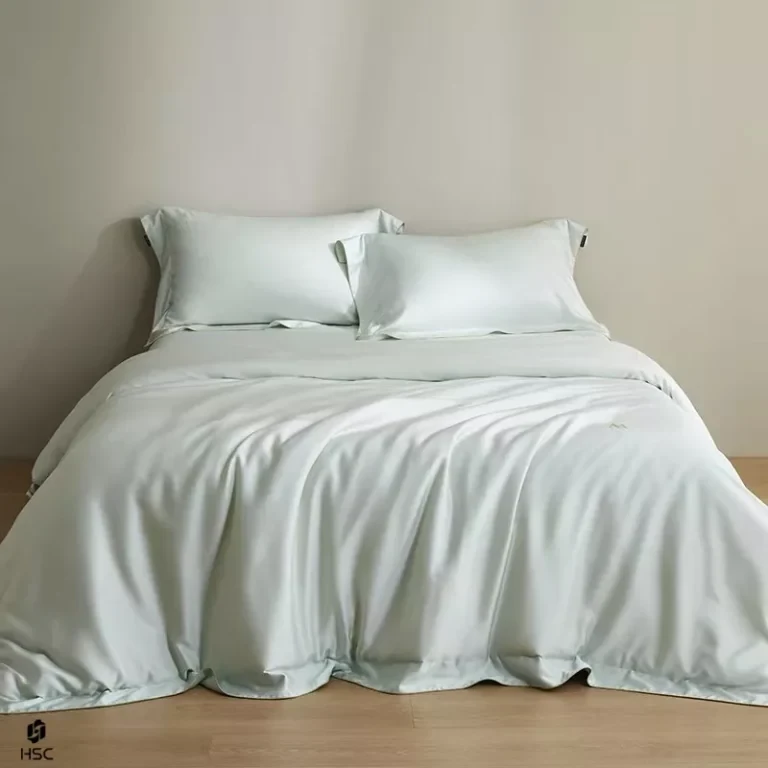
เดอะ ชุดเครื่องนอนไม้ไผ่ไลโอเซลล์ออร์แกนิก provides a useful product context because smooth bedding fabrics can make the cover feel refined while also allowing an insert to slide more readily if the internal attachment layout is weak. Surface feel and internal stability should be developed together.
Measure the Cover After the Agreed Care Cycle
The useful dimension is the internal cover space after washing, not only the flat-cut fabric size before sewing. Cotton, bamboo-derived cellulosic fabrics, linen blends, and synthetic blends can each respond differently to water, heat, and drying. Seams, piping, and closures can further reduce usable length or width by changing how the cover lies flat.
For a stable result, record cover length and width after the care method on the label, then compare those figures with the insert’s finished dimensions and loft. A cover that is too large allows the insert to wander. A cover that is too tight can compress the fill, strain the closure, and make corners difficult to fill.
| Design point | What to measure | What can go wrong |
| Internal cover length and width | Post-wash dimensions along usable seam lines | Insert gathers at one end or cannot fill corners |
| Tie position | Distance from true inner corner | Unsupported fabric pocket and corner migration |
| Tie length and strength | Knot security and seam attachment | Untying, tearing, or visible bulk |
| Closure opening | Usable opening width and pull strength | Difficult insertion or insert escape |
| Insert loft | Compressed and recovered thickness | Cover fit changes between seasons or fill weights |
Match the Attachment Layout to the Insert Type
A thin summer quilt and a high-loft duvet do not place the same stress on internal ties. A lightweight insert may stay relatively flat, while a filled duvet expands into the corners and pulls against the attachment points as it recovers. Four corner ties may be sufficient for a stable, well-sized lightweight insert; a bulkier format may benefit from reinforced corner construction or additional attachment logic where appropriate.
The first field mistake is approving the cover with a thin development insert and then selling it with a fuller production insert. The second is testing the ties only when the cover is lying flat. The real test includes lifting the cover, shaking it lightly, changing the bed, and laundering it. That shows whether the knot opens, the tie twists, or the insert folds over near a corner.
เอ cooling bamboo fiber mattress cover faces a related fit issue from another direction: elastic depth, mattress thickness, and fabric recovery determine whether a fitted layer stays smooth. Bedding performance is usually decided at these fabric-to-object interfaces, not from surface appearance alone.
When Corner Ties Are Not Enough
Corner ties are not enough when the cover and insert differ materially in size, when the insert corners have no usable loops, or when the fill is so bulky that it cannot spread into the cover corners without strain. In those cases, correct the dimensions, use compatible attachment points, or select a cover construction designed for the specific insert. Adding more ties to a poor size match only disguises the real issue.
Check the Closure Before Finalizing the Set
Buttons, zippers, and envelope closures create different insertion and retention behavior. The closure should be wide enough for the intended insert and durable enough for repeated pulling during laundering and bed making. For export orders, confirm the pull requirement, care instructions, trim material, and spare-trim policy in the approval pack rather than treating the closure as a decorative afterthought.
Turn Bedding Fit Into an Approval Standard
A bedding approval sheet should include the cover’s pre-wash and post-wash dimensions, the insert reference size, tie count and placement, closure type, fabric composition, fabric weight, seam construction, shrinkage method, and visual inspection points. Include a photo of the insert installed and one after the agreed care cycle. That makes it easier to catch a change in tie position or finished size before bulk packing begins.
สิ่งทอ HSC supports custom bedding development, and a clear brief should distinguish between a decorative bedding set and a cover intended to retain a specific insert size. State the target market, bed size naming system, insert dimensions, expected fill loft, care method, labeling, and packaging route from the start.
Bamboo lyocell and cotton bedding are often compared for handfeel and moisture behavior, but ชุดเครื่องนอนไม้ไผ่ไลโอเซลล์ also needs the same dimensional discipline. A smooth fabric does not compensate for a cover that has no room to retain the insert after laundering.
คำถามที่พบบ่อย
How long should duvet cover corner ties be?
They should be long enough to make a secure knot around the insert’s corner loop without pulling the corner fabric out of shape. The exact length depends on the tie material and loop design, so it should be verified with the actual insert rather than copied from a flat cover sample.
Why does a duvet cover become loose or tight after washing?
The cover fabric, seams, and trims can change dimension after washing and drying. If that post-wash size does not match the insert dimensions and loft, the cover can become either too loose, allowing migration, or too tight, compressing the insert and stressing the closure.
Can corner ties prevent every type of duvet bunching?
No. They help control corner migration, but they cannot correct an insert that is too small, too large, severely uneven in loft, or incompatible with the cover’s closure and internal space. The cover, insert, and care method need to be evaluated as one system.
เกี่ยวกับ HSC Textiles
เราคือกลุ่มบริษัทที่บูรณาการการผลิตและการค้าเข้าด้วยกัน – ยูแลนด์ กรุ๊ป บริษัทในเครือของเราได้แก่ HSC, Liaocheng Shanlian Textile Co., Ltd., Zhongfei และ DDL