A custom cushion cover for commercial and residential decor is cut to the outline and depth of that insert and held in position by an edge closure.
The outline of the insert determines the cut outline of the cushion cover with the addition of an allowance for compression and for seam(s). Standard contract specifications are set out in the plain linen throw pillow covers range.
Cover outline
The cloth should be a plain or twill weave of linen, of cotton, or of a mixture of linen and cotton, of sufficient weight and closeness of weave to withstand laundering.
The cover shall be seamed on all four sides.
Opposite sides shall be parallel and the corners square, so that a cushion cover laid flat along either axis aligns without puckering.
The finished size of the cushion cover must be cut smaller than the uncompressed insert to ensure positive filling of the cover:
- a dimensional reduction of 25 mm to 30 mm is standard for synthetic polyester cluster fiber
- a dimensional reduction of 50 mm is required for feather and down mixtures, so that a 50 cm square feather pad requires a 45 cm square cover
- a dimensional reduction of 30 mm is required along length and width for rectangular lumbar cushions, such as 30 cm by 50 cm units, to prevent slackness at the ends.
Where the cover is cut to the same size as the insert, the filling will fail to seat into the corners, and the upper corners will collapse when the cushion rests upright. Bespoke dimensions and fabric combinations are listed in the wholesale linen cotton cushion covers range.
Edge styles
A custom cushion cover may be cut with plain knife edges, with flanged borders, or with corded piping.
A cushion cover may be cut from a front deck and a back panel joined by a perimeter seam. The location of the seam(s) will vary according to the cover dimensions and the outline of the insert. It is preferable to locate the closure seam along the lower edge.
At the corners, where the fabric is joined, allowance must be made for the reduction in bulk due to seaming. The allowance at a corner will vary with:
- whether the edge is a plain knife edge or a flanged border
- the depth of the seam allowance and
- the thickness of the fabric.
Where a flanged border is specified, the width of the flange will vary with:
- the dimensions of the cushion
- the weight of the fabric and
- whether the corners are mitred at 45 degrees.
The corners of a flanged border should be reinforced to ensure the wings remain flat after commercial pressing.
Zipper closure
The cushion cover is secured by a concealed nylon zipper along the lower edge:
– The seams should not be puckered along the zipper tape.
– The zipper slider should move freely without catching on the seam allowance.
– The zipper tape should be securely attached.
The zipper opening is positioned along the lower edge of the cover.
The length of the opening determines the ease with which the insert is applied, with the addition of an allowance for corner clearance.
The length of the zipper opening will vary with the size of the cover:
- an opening of not less than 35 cm is required for square covers up to 45 cm
- an opening of not less than 40 cm is required for square covers of 50 cm and above
- an opening along the full long edge between corner stops is required for rectangular lumbar cushions.
If the zipper opening is too short, the seams at the ends of the zipper will tear when the insert is introduced. Both zipper stops must be secured with high-density bar-tacking or reinforced back-tacking for not less than 15 mm.
Choix du tissu
The type of fabric determines the durability of the cushion cover and its behavior in laundering.
The fabric may be cut from pure linen in a plain weave, from combed cotton, or from cotton-linen mixtures. The choice of weave will vary according to the required surface texture and the laundering routine. Combed cotton yarn and flax linen options give balanced tensile strength and a smooth finish.
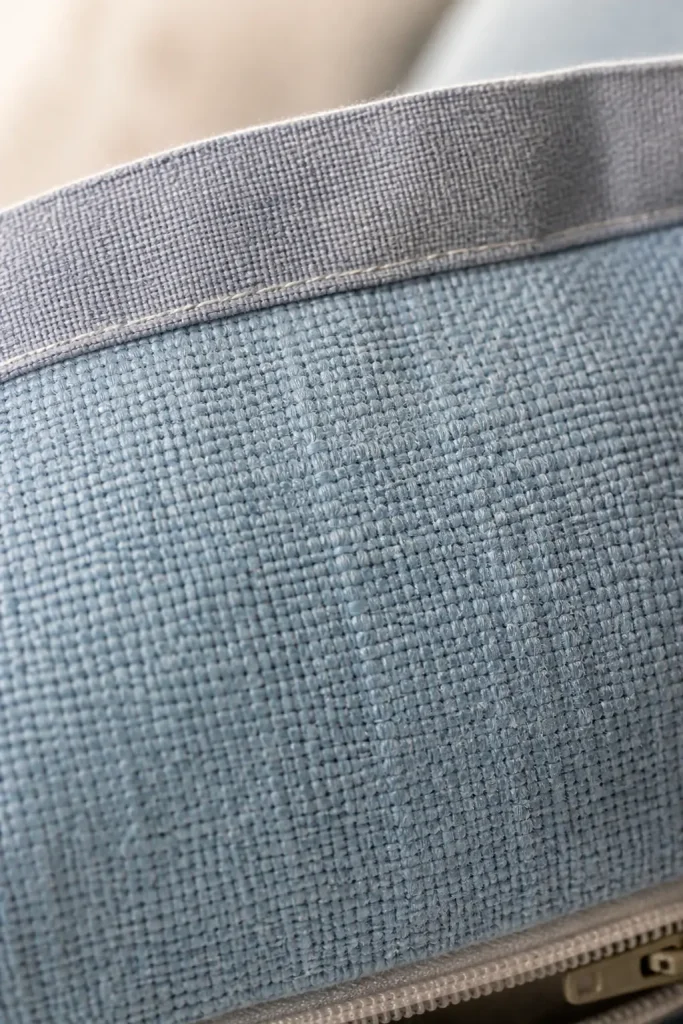
The fabric measure, or depth, of the cushion cover might need to accommodate any embroidery or fold which is to be displayed on the furniture.
The fabric measure should be sufficient to ensure the cloth is not transparent over dark fillings, while allowing water extraction during laundering.
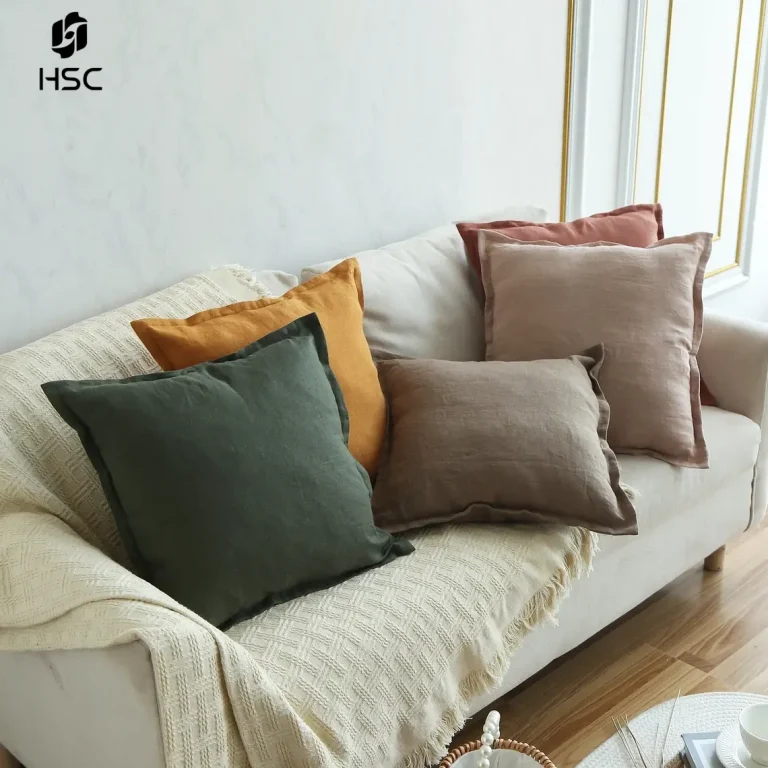
HSC Textile custom hotel lumbar and throw cushion covers for hospitality suites.
Interlining
When cushion inserts contain natural feathers, duck down, or loose fibers, open-weave face fabrics are vulnerable to quill penetration.
A down-proof cambric cotton lining is fitted where feather fillings are specified to prevent quill penetration through textured face fabrics:
- high-density cambric cotton meeting contract down-proof standards is standard
- the barrier lining is joined directly into the four perimeter seams with the face fabric to prevent shifting during laundering
- the lining material should maintain a soft hand and remain free from crinkling noise when compressed in use.
Coutures des angles
The perimeter seams take the strain when the insert is fitted into the cover:
- les coutures ne doivent pas former de fronces aux angles
- the perimeter seam is closed with a four-thread overlock or a reinforced French seam to enclose raw edges
- la jonction entre la couture d’angle verticale et le panneau supérieur doit être renforcée par une couture arrière sur au moins 15 mm.
The characteristic properties of natural linen, such as minor slubs and subtle yarn variations, are not considered defects. A seam that shows thread slippage or open needle holes under moderate tension is a defect. A zipper that binds, puckers along the tape, or derails during insert replacement is a defect. A corner that collapses inward or puckers after the insert is applied is a defect.
Marge de retrait
Allowance must be made for the reduction in dimensions due to commercial laundering.
Linen weaves exhibit between 3% and 5% shrinkage in length and 2% to 3% in width during commercial hot-water washing. The cut dimensions of the front deck and the back panel must be enlarged by this percentage.
Lorsque du tissu prérétréci est spécifié, le changement dimensionnel après lavage est limité à 2 %.
Essai de mise en place
It is essential that the correct fit of the cushion cover be verified prior to final making up. A fitting trial will reveal any discrepancies in the cut dimensions and in the position of the seam line. A trial fitting also allows the corner shape to be checked so that the contour is smooth and firm.
The cover has to cover the insert completely and, after being fitted in position, has to be free from creases.
Launder the trial sample according to commercial care instructions and compare before and after measurements. Fit the laundered sample over the same insert and check that the lower edge of the cover does not lift off the base when in position.
Dossiers de commande
Les renseignements suivants semblent nécessaires à la bonne exécution d’une commande :
(a) The cut size which the customer requires or the insert measurements on which this is based, from which the cut size is calculated by the maker.
(b) La marge de rentrage requise.
(c) Le type de tissu, avec le nombre de fils et le grammage.
(d) The type of edge closure, including whether the zipper is sewn along the whole edge or recessed between corners.
(e) Les détails de confection lorsqu’ils diffèrent de la norme, par exemple un type de point autre que le point noué.
(f) La méthode d’emballage si elle diffère de la norme.
Préparer une demande de renseignements
HSC Textile lists decorative cushions, throw pillow covers, and contract textiles in its product range. A dimensioned sketch and the target insert specification may be forwarded when discussing an order.
HSC Textile custom throw pillow covers for commercial hospitality and residential decor.
À propos de HSC Textiles
Nous sommes un groupe intégrant la fabrication et le commerce – ULAND GROUP. Nos filiales comprennent HSC Textiles, Liaocheng Shanlian Textile Co., Ltd., Zhongfei.