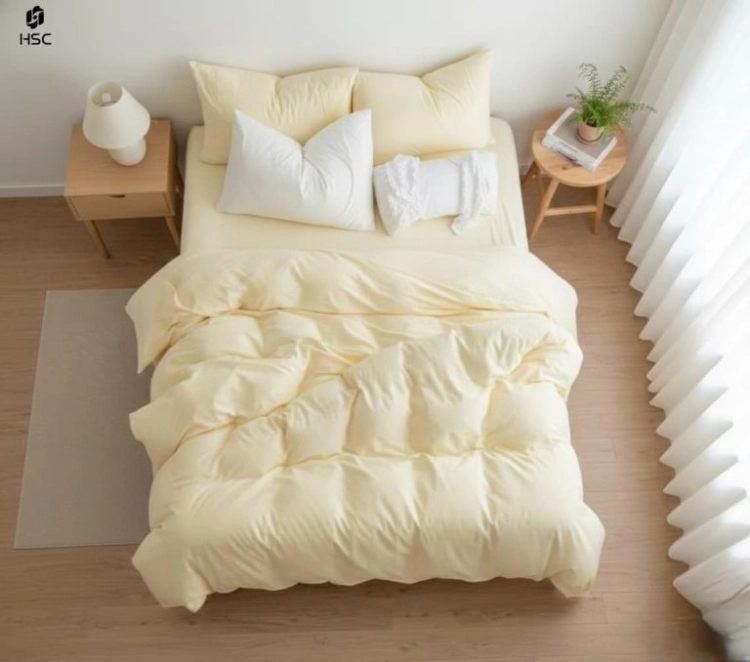
A mood board and a size name leave too much for a bedsheet factory to guess. Before sewing starts, an OEM brief needs finished dimensions, fabric details, colours, construction, branding and packing instructions. Artwork belongs in the brief for custom printed bedding, but it cannot replace those production details.

Work through the brief first, then record what happens at sampling, approval and bulk inspection. That record lets the buyer, merchandiser and factory floor follow the same changes.
Step 1: Define the item without relying on “queen” or “king”
What does “queen” mean for this order? The factory needs the sheet’s finished width and length, not just the size name. For a fitted version, write down the mattress dimensions as well. The depth deserves a separate check: does that figure include the fabric tucked underneath, and where is the elastic supposed to run?
There is a similar ambiguity in “four-piece set.” A duvet cover and two pillowcases account for three pieces; the fourth might be a flat sheet or a fitted one. Spell out which it is. Otherwise two people can agree on the set name while expecting different contents.
Add construction notes that affect use:
- flat or fitted sheet;
- elastic around all four sides or only at the corners;
- pillowcase envelope depth or other closure;
- duvet-cover closure and orientation;
- seam type, edge finish and any piping;
- finished-size tolerance to be confirmed with the supplier.
Use these details when checking the sample. A set may look right on a display bed while its measurements or construction still differ from the order.
Step 2: Lock the fabric question before choosing a shade
Think about what happens to the fabric in use. A hotel buyer may care most about repeated laundering and being able to replace sets consistently. For retail, the feel, drape and packed volume may carry more weight. The fibre composition won’t answer all of that. Construction and weight, or a clearly stated thread-count basis, belong in the fabric discussion too.
If you are considering bamboo lyocell, the HSC Textiles four-piece bamboo lyocell bedding set shows a configurable set format and colour option. Treat those page details as a product reference, then confirm the exact fabric specification for the planned order.
A shade on a phone is a useful conversation starter, but keep the approval tied to a swatch. Screens change what you see; so does the construction of the cloth. Give the accepted swatch a code and use it beside the relevant quantities. With several colours in an order, that code is what connects the quantity table to the piece of fabric everyone approved.
Step 3: Send one artwork package, not separate message attachments
Consider a small motif near a seam. It can look centred in the artwork and sit off-centre after cutting. For custom printed bedding, the file package therefore needs more than the repeat image: include colour references, scale, direction and placement, showing where seams interrupt the design.
A logo instruction such as “add our brand” leaves several decisions open. Is it going on the sheet, a woven label, the care label, an insert or the bag? Give its size and position, then include the approved spelling and vector file. Check the message history as well: the factory shouldn’t have to decide which of several “latest” attachments is actually final.
The HSC Textiles customization service includes colour matching and private-label support. The useful next step is to convert those capabilities into a file list and approval owner for the specific project.
Step 4: Approve physical references in a fixed order

Approve colour and construction separately, with a clear reference for each decision. The sequence below keeps those approvals in order:
Lab dip or printed strike-off
Approve the colour on the intended substrate and identify the accepted option by code and date. The HSC Textiles OEM/ODM process lists 3–5 days for lab dips. Printed work may need a different sample route, so confirm the applicable timing in the project schedule.
Construction sample
Unpack the sample as well as looking at it. Does the packaging open and close as intended? Measure the bedding and try it on the target mattress if one is available. Work around the elastic, seams and closures, then check label direction and the pattern at the edges. HSC Textiles gives 7–10 days for sample customization. Treat that as a published reference; the materials and complexity still need to fit the project schedule.
Corrected pre-production sample
Sometimes the comments change the sample itself: a different dimension, fabric, print position or construction. In that case, a corrected pre-production sample gives the buyer something to approve. A photograph can’t settle a question about feel or fit, and it may not settle shade either. Once accepted, the physical piece and specification need the same approval code.
Bulk release
The dated bulk release is the point at which the open questions must be closed. Put the accepted specification, size-and-colour quantities, artwork, labels, packing layout and reference list together. Check for old versions before releasing the work. Leaving them in circulation gives production a choice that it should no longer have.
Step 5: Treat MOQ as a design constraint
Which part of the order is being customized? HSC Textiles gives different minimums for different work: logo customization starts at 100 pieces, style customization at 300, and fabric customization at 1,000, with 500 pieces per colour. Those are the modes stated on its OEM/ODM page. Applying one of those figures to every bedsheet enquiry would miss the distinction.
Put the proposed range into a SKU matrix before deciding that the total quantity is enough. Dividing it among six colour-size combinations can leave awkwardly small runs. That is the point to ask about a stock base: which elements can use one, and which need new fabric or construction?
A narrower range may be easier to manage here. There is more volume left in each combination for production and replacement stock, fewer tiny mixed runs to interpret, and less to work through at approval.
Step 6: Check bulk goods against the approved file
The top set in one carton cannot tell you much about the other sizes and colours. Sample across those combinations and across cartons. Keep the approved references beside the goods while checking dimensions, shade, print placement, seams, closures, labels and what is actually inside the pack.
Some checks need the bedding in use. Put the fitted pocket on the intended mattress depth and make up the bed to see which way a directional print faces. Other checks belong at the carton: where sizes are mixed, its mark must agree with the inner packs before the shipment leaves.
If something differs, write down the quantity affected before deciding what to do with it. Acceptance, rework and replacement are different outcomes. The approval needs to say which applies and to which exception. “Looks okay” is too open-ended: someone reading it later may take it to cover the whole lot.
Keep the order reproducible
Imagine handing the repeat order to a colleague who never saw the sampling emails. They should be able to find the approved sample code, specification, artwork, colour references, packaging file and inspection result together. Start the next purchase order from that file, then identify the requested changes.
With that record, the buyer can compare seasons and the factory can reproduce the order without reconstructing an old conversation.
About HSC Textiles
We are a group company integrating manufacturing and trade – ULAND GROUP. Our subsidiaries include HSC Textiles, Liaocheng Shanlian Textile Co., Ltd., Zhongfei, and DDL.