Pajama fit depends on how reliably the knit, seams, waistband, and cuffs recover after movement and laundering. A cotton knit pajama set is worn in motion rather than displayed flat. Knees bend, elbows reach, waistbands stretch, and the fabric repeatedly returns to shape after sleep and laundering. A garment can be soft and breathable yet lose its appearance if the knit recovery, seam stretch, cuff tension, or shrinkage is not controlled.
The risk is highest at transitions: a waistband meets the body, a sleeve joins the armhole, and a cuff changes the effective opening. These areas need a different review from the center of the fabric. Finished-garment testing shows how the knit, thread, stitch type, and pattern work together.

Test Stretch in the Direction the Body Uses It
Knit fabric stretches differently across the course, along the wale, and on the bias. A pajama top may need chest and arm movement, while shorts need recovery at the waist and seat. Measure extension and recovery in the actual garment panels. Do not approve from a single fabric strip cut in an unknown direction.
Recovery Matters More Than Maximum Extension
Maximum stretch shows how far a fabric can move before discomfort or damage. Recovery shows how much shape returns after the load is removed. Poor recovery produces bagged knees, a loose waistband, stretched cuffs, and a neckline that no longer sits flat. Repeat the load cycle because a first release may look better than the tenth. Measure recovery with a marked gauge length and defined load.
Elastane, elastic tape, rib cuffs, and sewing thread each contribute to the result. If the waistband relaxes faster than the body fabric, the garment may slide. If it is too strong, it creates pressure and seam distortion. State the intended extension and recovery tolerance for the finished size set.
Seam Construction Controls Movement
A seam can stretch with a knit when its stitch structure has enough give and the thread is suitable. A rigid seam can break during dressing or pull the fabric into a ridge. Overlock width, stitch density, needle size, thread tension, seam allowance, and reinforcement should be reviewed at armholes, side seams, crotch seams, and waistband joins. Compare seam and fabric extension in the same direction.
Watch Spirality and Side-Seam Twist
Some knitted fabrics twist after washing because loops and finishing tensions are not balanced. The side seam then rotates toward the front or back, changing appearance and comfort. Measure garment spirality after the same wash and dry method used for production. A pattern adjustment cannot fully correct a fabric that has unstable construction.
Cuffs and hems reveal the problem quickly. A twisted hem may rise on one side, while a rib cuff may flare after drying. Inspect sleeve and leg openings on a flat table and on a body form. Record whether the issue comes from the fabric, cutting direction, sewing feed, or laundering.
Use Laundering to Expose the Real Garment
Cotton can shrink, especially when heat and mechanical action are high. Color, print, labels, elastic, and thread may change at different rates. Measure chest, body, sleeve, inseam, waistband, and cuff before and after the agreed care cycle. Photograph the garment on the same form so drape and seam behavior can be compared.
Pilling is affected by fiber length, yarn construction, knit structure, friction, and washing. A soft surface is not automatically a pilling-resistant surface. Test the areas that rub against bedding and the garment itself. If the set is marketed for winter lounging, include the thicker or brushed version rather than testing only a light sample.
Review a Finished Women’s Cotton Pajama Set
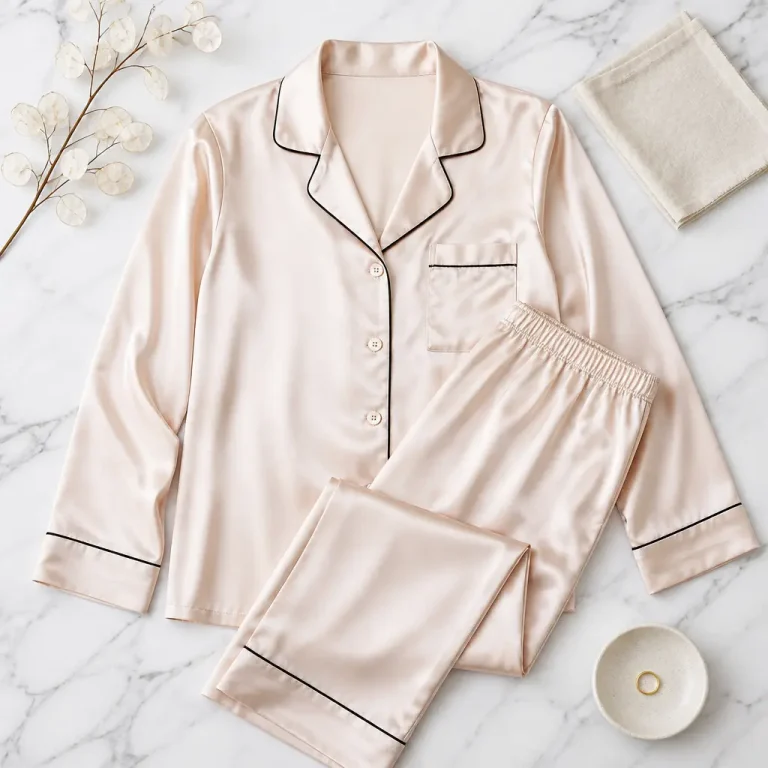
The Women’s Cotton Knit Pajama Set gives HSC Textiles a finished reference for checking knit recovery, waistband tension, cuff shape, seam stretch, spirality, shrinkage, color, and size grading. Approve the top and bottom together because a matching set can fail when only one component changes after laundering.

HSC Textiles supplies cotton pajamas for wholesale and custom programs. A custom order should record fabric construction, weight, color standard, size chart, stitch and thread requirements, labels, packaging, care symbols, and post-wash tolerances. Company information is available through About HSC Textiles once the product standard is defined.
Approve Trim, Labels, and Packaging With the Knit
Elastic, drawcords, buttons, snaps, labels, and prints can all change the garment’s stretch and recovery. A stiff care label may irritate the neck. A heavy drawcord can pull a soft waistband. Test trims after laundering and check that packaging compression does not leave a permanent fold across a sleeve or leg.
Bulk inspection should sample several cartons and fabric lots. Compare shade, measurements, seam flatness, waistband recovery, cuff opening, spirality, pilling, labels, and package count after conditioning. Keep one approved production set for later comparison when a raw material or sewing line changes.
Use Movement Tests Alongside Flat Measurements
A garment can meet chest, waist, and inseam measurements and still restrict reaching, sitting, or bending. Use a body form or wear trial to check arm lift, elbow bend, sitting, knee bend, and waistband recovery. Record seam stress, riding up, neckline movement, and the time the fabric needs to return after the movement ends.
Size grading should preserve stretch and recovery across the range. Adding the same amount to every width may change cuff pressure, neckline stability, pocket position, and rise. Check the smallest and largest size after laundering rather than assuming the middle-size construction scales automatically.
Trace Spirality to Fabric and Cutting
Mark wale and course direction before cutting a trial garment. After washing, compare fabric twist with side-seam rotation. If fabric is stable but the seam turns, review cutting alignment and differential feed. If the fabric itself twists, changing the sewing line alone will not correct the root cause.
Check Recovery After a Full Night’s Load
Short tensile tests reveal material behavior, but pajamas remain bent and compressed for hours. Hold knee, elbow, and waistband areas under a defined extension for a longer period, release them, and measure immediate and delayed recovery. Compare the result before and after washing. This shows whether bagging is temporary or becomes a lasting shape change.
Pocket openings and button plackets can restrict a soft knit. Load pockets with a representative item, open and close buttons, and inspect stabilization at the placket. Reinforcement should prevent distortion without creating a stiff patch that pulls the garment during sleep.
Colorfastness should include laundering, perspiration, rubbing, and contact with light bedding when relevant. A dark pajama may pass visual shade approval and transfer color during wear. Test the finished garment with trims and labels because sewing thread or print can behave differently from the cotton body.
FAQ
Q1: Why does knit recovery matter in cotton pajamas?
A: It controls whether waistbands, knees, cuffs, necklines, and body panels return to their intended shape after movement and washing.
Q2: What is garment spirality?
A: It is the twisting of a knitted garment or seam after laundering, often caused by fabric construction, finishing, cutting direction, or sewing tension.
Q3: Should seam stretch be measured on fabric or on the garment?
A: Both can help, but the finished garment reveals the interaction between knit recovery, stitch structure, thread, pattern, and trim.
Q4: How can cotton pajama shrinkage be evaluated?
A: Measure key garment points before and after the agreed wash and dry cycle under controlled conditioning.
Q5: What should be approved for a wholesale women’s cotton pajama set?
A: Approve fabric, weight, color, size grading, seam and thread, waistband, cuffs, trims, labels, packaging, care cycle, and post-wash tolerances.
About HSC Textiles
We are a group company integrating manufacturing and trade – ULAND GROUP. Our subsidiaries include HSC, Liaocheng Shanlian Textile Co., Ltd., Zhongfei, and DDL.