
A bamboo duvet cover is known for its smooth feeling, cool touch and lightweight. But as with all items, a wrong wash procedure and a poor workmanship can cause a bamboo comforter to fuzz, to shrink in size or to ride up to one corner while being in bed. Most of these problems can be avoided. In this article we will tell you why these problems can occur, how you should wash your bamboo duvet and what you should look out for when buying bamboo duvet covers for retail, for a hotel or for your private label.
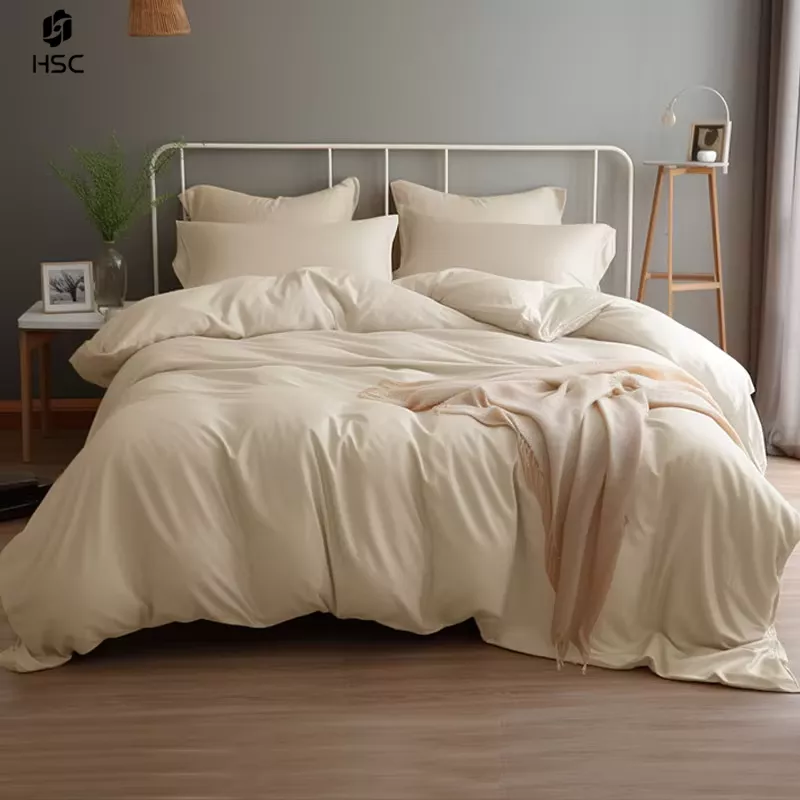
Why Do Bamboo Duvet Covers Pill Shrink or Slip?
The three complaints have different causes. Pilling begins at the fabric surface, shrinkage comes from fiber and yarn movement during laundering, and slipping happens inside the cover. Calling all three a general “quality problem” hides the real solution.
Pilling Usually Starts with Friction
Pills are tangles of loose fibers created by repeated rubbing. Common trouble spots include the foot of the bed, the sleeper’s side, and fabric washed against towels, open zippers, or rough trims.
Soft bamboo derived fabrics can get marked before the base fabric wears out. Wash the cover on its own from rough garments and don’t over fill the drum. Excess detergent can leave residue on the fabric making it stiff and abrasive.
Shrinkage Is Driven by Heat and Agitation
Moisture, heat, and mechanical action let woven yarns relax and move. Hot water and high dryer heat increase that risk. Poor fabric stabilization or a tight cutting allowance makes the change more visible.
Thread count alone does not prove dimensional stability. A 300TC figure describes fabric density, but buyers should also check fiber content, weave, finishing, washed size, and tolerance. The HSC knowledge base lists 300TC and 400TC bamboo options and recommends cold washing with mild detergent.
Slipping Comes from Fit and Weak Anchoring
A silky surface lowers friction between the insert and cover. That improves hand feel, but the insert may drift when the cover has too much spare room or too few secure ties.
The insert and cover should have closely matched dimensions. The HSC Lightweight Cool Bamboo Duvet Cover Set uses eight interior fabric tabs to distribute restraint around the insert. Its listed specifications include a 300TC plain weave, bamboo viscose, bamboo lyocell or blended options, custom colors, and standard regional sizes.

How Should You Wash Bamboo Duvet Covers to Prevent Pilling and Shrinkage?
A safe routine needs lower friction, moderate detergent, and less heat. Each step below controls a specific source of wear.
Use This Seven-Step Care Routine
- Close the cover before washingto limit twisting and protect the interior tabs.
- Wash with similar smooth fabricsrather than towels, denim, or exposed zippers.
- Choose cold water and a gentle cycleto reduce abrasion and size change.
- Measure mild liquid detergent carefully.Avoid chlorine bleach unless the care label permits it.
- Skip fabric softenerbecause coating residue can change absorbency and feel.
- Use a moderate spin speedto reduce hard creasing and seam strain.
- Air dry or tumble dry on low.Remove the cover promptly and smooth it while slightly damp.
The customer knowledge base also recommends cold water and mild detergent for bamboo products.
A Laundry Settings Table for Bamboo Duvet Covers
| Laundry Decision | Better Choice | Avoid | Risk Controlled |
| Water | Cold or cool | Hot | Shrinkage and color stress |
| Cycle | Gentle | Heavy-duty | Surface pilling |
| Load | Smooth bedding | Towels and denim | Abrasion |
| Detergent | Mild, measured dose | Bleach or excess detergent | Fiber damage and residue |
| Drying | Air dry or low heat | Prolonged high heat | Size loss |
| Ironing | Low heat if allowed | Very hot iron | Heat damage |
Check the sewn-in care label first. Blends, prints, dyes, and special finishes can change the correct setting.
How Can Better Construction Stop a Duvet from Slipping?
Laundry care cannot correct a weak internal design. A stable cover depends on finished dimensions, anchor count, tab strength, seam placement, and closure quality. Those details must still work after washing.
Match the Insert Before Judging the Ties
Measure the insert while it lies flat, then compare it with the finished cover size rather than relying only on “Queen” or “King.” Regional sizes differ. The product page lists a US Queen duvet cover at 86 × 90 inches and an Australian Queen at 210 × 210 cm.
An oversized cover leaves empty pockets where the fill can migrate. An undersized one compresses the insert and loads the ties. Custom measurements are often safer for non-standard hotel or private-label projects.
Inspect Tabs Seams and Closures
Check these points on the approval sample:
- Eight anchors are useful when the insert has matching loops.
- Each tab should be secured inside the seam allowance.
- The attachment area should resist firm hand pulling without distortion.
- Seams should remain flat after laundering.
- The opening should allow easy insertion and stay securely closed.
- The care label should state clear wash and drying limits.
The HSC Textiles service system covers specification matching, custom development, full-process inspection, delivery follow-up, and quality complaint handling. This matters because a sound sample design must be repeated accurately in bulk production.
What Should B2B Buyers Confirm Before Ordering Bamboo Duvet Covers?
For retailers, hotels, and bedding labels, complaints often start with a vague specification. “Soft bamboo cover” is not enough. The purchase sheet should define material, construction, washed dimensions, test criteria, packaging, and acceptable tolerances.
Operational Data That Matters in Bedding Procurement
HSC Textiles reports over 20 years of textile experience, a 3,200-square-meter manufacturing base, service to more than 3,000 clients in over 30 countries, and a 99% order-fulfillment rate. The product page lists output capacity of up to 10,000 sets per month. These figures do not replace testing, but they help buyers assess repeat-order and delivery capacity.
Confirm these measurable details:
- Exact composition, including bamboo viscose, bamboo lyocell, or blend percentage
- Thread count, weave, fabric weight, and finish
- Finished dimensions and shrinkage tolerance after laundering
- Pilling method and minimum acceptance grade
- Colorfastness requirement
- Tab number, position, material, and pull strength
- Seam type, closure, care label, and packaging
Approve a Washed Sample Not Only a New One
A fresh sample has not met detergent, heat, or repeated friction. Run several care cycles before bulk approval. Measure the cover before and after washing, inspect the surface, check the tabs, and test it with the intended insert.
The HSC Textiles OEM and ODM process covers sample development, feedback, quotation, and a contract that records standards, quantity, delivery time, and other requirements. The service knowledge base also sets out order confirmation, first-sample approval, bulk production, and shipping after completion.
What Is the Most Practical Prevention Plan?
At home, use cold water, a gentle cycle, mild detergent, and low heat. Keep rough fabrics out of the load. Fasten the insert to every matching tab and use the correct cover size.
For bulk sourcing, do not approve from touch alone. Ask for composition, washed measurements, pilling criteria, tab layout, and a laundered sample. HSC Textiles provides sample and customization guidance for specifications, samples, and quality checks.
The best decision is straightforward: choose a stable woven fabric, verify it after washing, and pair it with a correctly sized insert and enough secure anchor points. That solves each problem at its source.
FAQ
Q1: Can Bamboo Duvet Covers Go in a Washing Machine?
A: Yes. Use cold water, a gentle cycle, mild detergent, and similar smooth fabrics. Follow the sewn-in care label.
Q2: Does a Higher Thread Count Stop Bamboo Bedding from Pilling?
A: Not by itself. Yarn quality, weave, finishing, friction, detergent, and drying heat also matter.
Q3: How Many Ties Should a Duvet Cover Have?
A: Four ties secure the corners, while eight well-positioned tabs give better control when the insert has matching loops.
Q4: Why Did My Bamboo Duvet Cover Shrink After One Wash?
A: Hot water, high dryer heat, strong agitation, or unstable dimensions may be responsible. Use low-temperature care and measure before washing.
Q5: Can HSC Textiles Customize the Size Tabs and Packaging?
A: Yes. HSC Textiles supports custom size, fabric, color, labels, logos, and packaging through confirmed OEM or ODM specifications.
About HSC Textiles
We are a group company integrating manufacturing and trade – ULAND GROUP. Our subsidiaries include HSC, Liaocheng Shanlian Textile Co., Ltd., Zhongfei, and DDL.