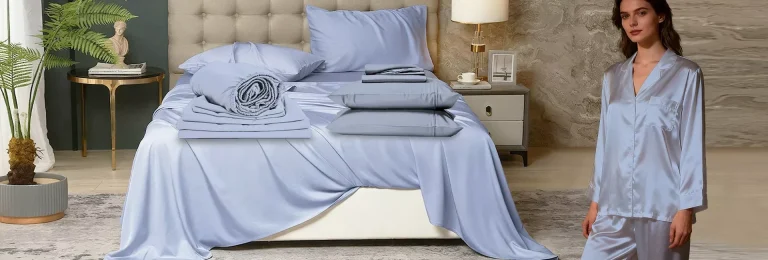
Adding ruffles to cotton bedding can give it a very high end look, however, retailers are often worried that the extra fabric and complex construction will kill the margin. Making items look premium is not about adding expensive decoration, it’s about proportion, contrast, finish and presentation and this guide explains how to select ruffles, cotton fabrics, colors and bedding sizes as well as checks to ensure quality, all to add value to your collection without increasing production or holding too much inventory.
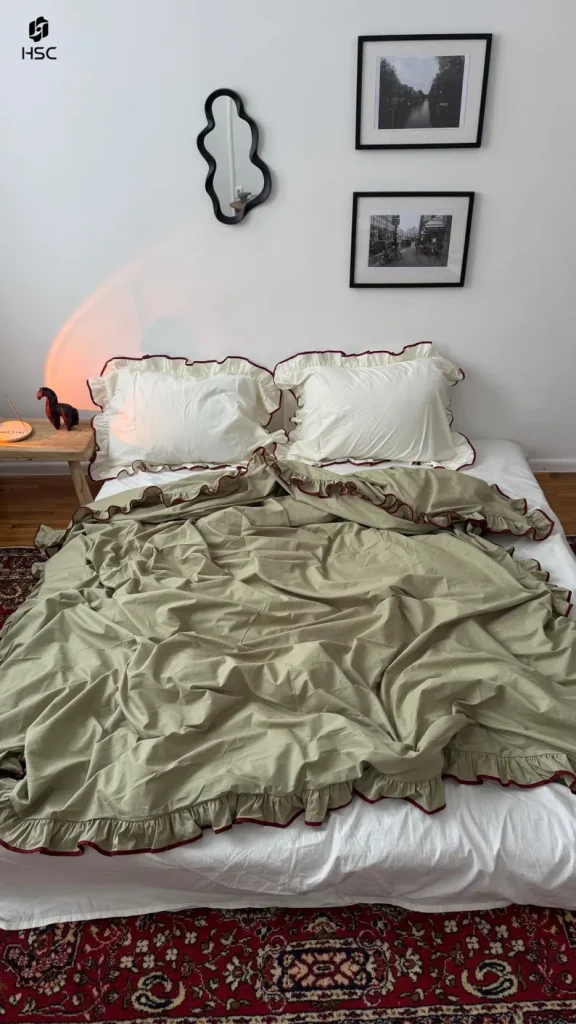
Why Can Ruffled Cotton Bedding Look More Expensive Than It Is?
Bedding can be premium without excessive embroidery or expensive fibers. A controlled decorative edge can add depth to a simple duvet cover or pillowcase and finish it off. Cotton is a great fabric for this type of design because it is soft, breathable, durable, washable and is a familiar fabric to most consumers.
Use Ruffle Proportion as a Design Tool
The gathering ratio matters more than the amount of decoration. A low ratio can look flat, while an excessive ratio adds bulk, sewing time, and fabric waste.
A practical method is to test 1.5:1 and 2:1 gathering ratios:
Finished edge length × gathering ratio = ruffle strip length
For a 200 cm duvet edge, a 1.6:1 ratio needs about 320 cm of strip before seam allowances. Retailers can limit ruffles to visible duvet or pillowcase edges instead of trimming every seam. This preserves the front-facing effect with less material and labor.
Let Contrast Trim Create Visual Structure
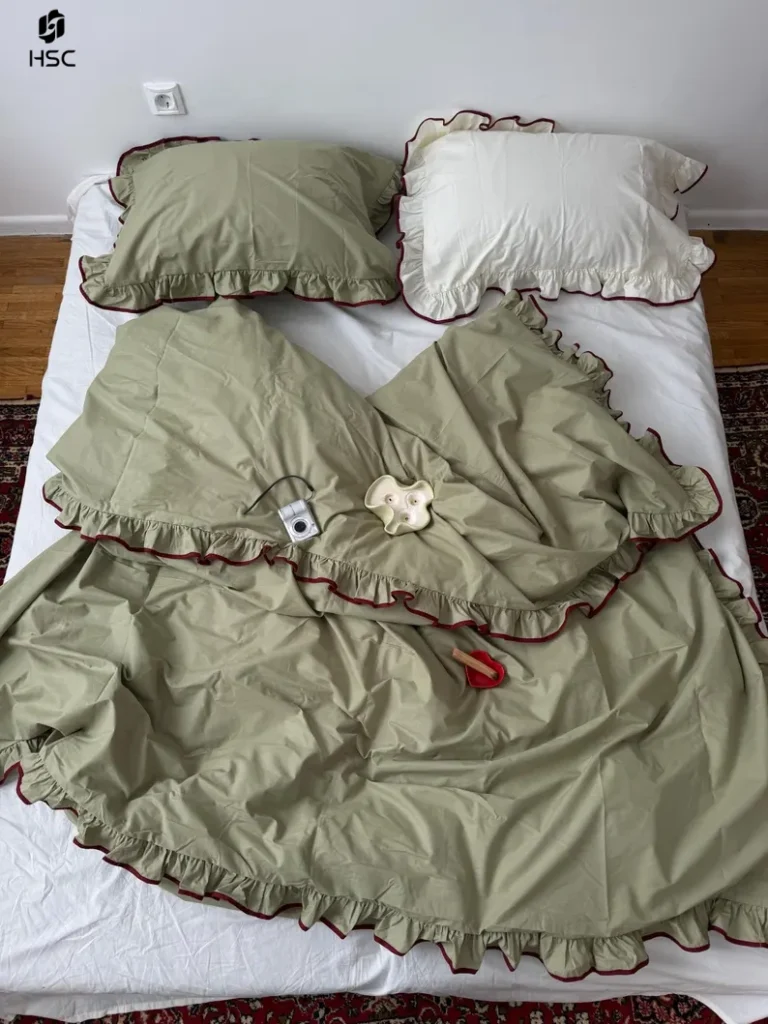
Contrast trim makes the ruffle look deliberate. A narrow border can define the duvet cover, connect the pillowcases, and make a solid-color set easier to merchandise.
For a restrained premium look, we recommend:
- One main color and one trim color
- Consistent trim width across every component
- Matching ruffle depth on paired pillowcases
- Hidden or well-aligned closures
The HSC Factory Direct Supply Wholesale Ruffled Cotton Bedding Set Contrast Trim Design Customizable Sizes Styles Bedding combines these cost-aware features in a format that retailers can adapt by size, color, and style.
Which Specifications Protect a Premium Look?
A low quotation becomes expensive when bedding shrinks, twists, fades, or arrives in the wrong market size. Buyers should define measurable specifications before approving the sample.
A Cost-Control Specification Table
|
Specification |
Premium Effect |
Cost-Control Decision |
|
Cotton construction |
Soft, breathable hand feel |
Select the weave by climate, not the highest thread count |
|
Ruffle depth |
Creates volume |
Use deeper ruffles only on visible areas |
|
Gathering ratio |
Controls fullness |
Prototype two ratios before bulk production |
|
Contrast trim |
Frames the set |
Use one standard trim width |
|
Custom sizing |
Improves fit |
Launch only proven regional sizes |
|
Color palette |
Builds coordination |
Start with core neutrals and one seasonal shade |
|
Packaging |
Improves presentation |
Choose a compact bag and insert card over rigid boxes |
Do Not Use Thread Count as the Only Quality Signal
Thread count means the number of threads within a square inch of fabric. Available specifications list 300TC and 400TC reference points, but a higher number should not replace checks for yarn quality, weave balance, breathability, shrinkage, and colorfastness.
A smooth 400TC fabric may suit a polished collection, while a breathable 300TC construction may work better in warm climates or value-focused retail. We recommend comparing washed samples under the same conditions.
How Can Retailers Lower Costs Without Making Bedding Look Cheap?
The strongest savings come from simplifying invisible complexity. Removing every decorative detail may cut the quotation, but it also removes the reason a customer would pay more.
Customize Only the Features Customers Notice
HSC Textiles supports fabric, design, size, color, logo, and packaging customization. Instead of changing every component, retailers can focus on three high-impact variables:
· Ruffle placement
· Contrast color
· Market-specific dimensions
Keep closures, inner seams, care labels, and packing methods standardized. This reduces sample revisions and makes repeat orders easier. Through its OEM and ODM service, HSC Textiles can develop private-label details without creating a different construction for every color.
What Do Industry Sizing Data Tell Retailers?
Regional size names are not interchangeable. Supplied bedding data list a US Queen mattress at 60 × 80 inches and an Australian Queen at 152 × 203 cm. A US King is 78 × 80 inches, while an Australian King is 180 × 203 cm. Duvet dimensions also differ.
A “Queen” label alone is not a production specification. Retailers should place finished measurements on the order sheet, packaging, and product page. Accurate sizing can prevent returns more effectively than another decorative feature.
How Should Buyers Approve Quality Before Bulk Production?
A premium appearance must survive washing, packing, and daily use. We advise testing the complete set because ruffle seams and contrast trim can react differently from the main fabric.
Run a Five-Part Sample Check
Check the sample before and after washing:
- Measure duvet covers, sheets, and pillowcases
- Inspect ruffle depth and gathering consistency
- Check trim alignment at corners and closures
- Test pale and dark colors for transfer
- Review seam strength, loose threads, and puckering
Cotton is easy to maintain, but results still depend on fabric construction and sewing control. The supplied bedding information also stresses inspection from raw materials through finished products.
Verify the Production and Delivery Process
The HSC Textiles service process covers product confirmation, first-sample approval, bulk production, and shipment. Supplied company information records raw-material traceability, finished-product inspection, and a stated 99% on-time delivery rate.
Planning data list a 100-piece MOQ and estimated transit times of 7–10 days by express, 15–20 days by air, and 30–45 days by sea. Freight also depends on weight, inland charges, and customs costs.
Buyers should verify whether OEKO-TEX or GOTS documentation applies to the exact fabric and order rather than assuming one certificate covers every item.
What Is the Best Retail Strategy for Ruffled Cotton Bedding?
The lowest-risk strategy is to repeat one recognizable design system across a controlled size and color range. A medium ruffle, consistent contrast trim, washable cotton, and accurate regional sizing can deliver a premium look without expensive embellishment.
We recommend this launch sequence:
· Select one cotton construction for the target climate.
· Compare two ruffle ratios on finished samples.
· Approve shrinkage, colorfastness, and dimensions after washing.
· Launch core sizes and two or three coordinated colors.
· Add seasonal shades only after sales data confirms demand.
Retailers can review HSC Textiles’ project and customization cases and request a sample based on exact fabric, measurements, trim, packaging, and target price. The final rule is simple: spend on details customers see and measure every detail that can cause a return.
FAQ
Q1: Does adding ruffles always increase bedding costs significantly?
A: No. Cost depends on ruffle depth, gathering ratio, placement, fabric use, and sewing time. HSC Textiles can limit decoration to visible edges while retaining a premium appearance.
Q2: Is 400TC cotton always better than 300TC cotton?
A: No. A higher thread count may feel smoother, but weave, yarn quality, breathability, and finishing also affect performance.
Q3: Can ruffled cotton bedding be customized for different countries?
A: Yes. HSC Textiles can customize sizes, colors, trim, labels, and packaging for regional bedding standards.
Q4: What should retailers inspect in a pre-production sample?
A: Check dimensions, shrinkage, colorfastness, seam quality, trim alignment, ruffle fullness, closures, and packaging.
Q5: How can retailers avoid excess inventory?
A: Start with core sizes, a standard construction, and a limited color palette. Expand only after sales data identifies the best combinations.
About HSC Textiles
We are a group company integrating manufacturing and trade – ULAND GROUP. Our subsidiaries include HSC, Liaocheng Shanlian Textile Co., Ltd., Zhongfei, and DDL.